

Versogen
PiperION Anion Exchange Resin 陰離子交換樹脂
Versogen 的 PiperION® 樹脂材料是一種粉末形式的功能化樹脂材料。此粉末可用於製造您自己的 PiperION® 分散體(也稱為離聚物)。分散體或離聚物是 PiperION® 薄膜實現卓越性能的關鍵成分之一。分散體通常用於製備陽極和陰極催化劑油墨或漿料。催化劑層內分散體的存在將顯著增強催化劑層中的離子傳導現象,因此具有更好的電化學性質。分散體也可用於製造自支撐膜和機械增強膜。 PiperION® 分散體屬於分散體產品的陰離子交換類別,應用於陰離子轉移對電化學性質至關重要的應用。
PiperION® 樹脂由功能化聚(芳基哌啶鎓)聚合物製成。下面提供了聚(芳基哌啶鎓)樹脂材料的一般化學結構。目前該樹脂粉末的規格為每瓶 0.8 公克。
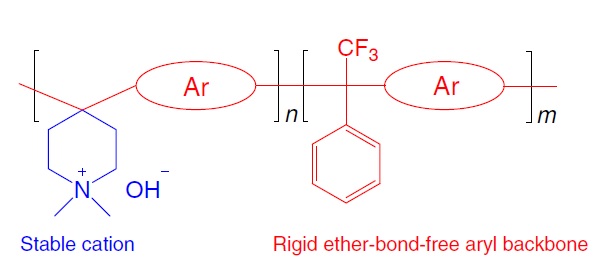
-由於剛性的無醚鍵芳基主鏈,在 1-14 pH 範圍內具有出色的化學耐久性和穩定性 –
在寬溫度範圍內具有長壽命運行能力
-製造具有卓越離子電導率的陽極和陰極催化劑層
-製造自組裝-支撐膜或機械增強膜
通常使用陰離子交換樹脂材料的方法是將其溶解在適當的溶劑系統中,以獲得溶解的聚合物溶液來製造其他相關產品。 PiperION® 分散體(或任何其他分散體)通常以原始形式使用,然後由分散體材料產生的產品將轉化為所需的離子形式。
任何含有 PiperION® 分散體的產品(例如催化氣體擴散層、氣體擴散電極、MEA、CCM)如果要用於標準鹼性燃料電池/電解應用,以將離子轉化為離子,則應遵循以下協議導電PiperION ® 從碳酸氫鹽形式到氫氧化物形式。
如果 PiperION® 分散體製成的產品是膜,則在浸入膜之前,請讓膜在環境條件下放置 1 小時(無需蓋板)。如果產品是 CCM(不含 GDL),則在浸沒之前讓 CCM 在沒有任何覆蓋膜或背襯膜的情況下在環境條件下靜置 1 小時。如果產品是 MEA(意味著 GDL 永久粘合到膜上),則離子導電部件的轉換需要在 MEA 受到約束或機械夾緊力作用下的設置內進行,並且不建議移除轉換後的MEA,以防止GDL 從膜表面分層。如果 PiperION® 分散體製成的產品是催化 GDL 或 GDE,則可以立即完成浸沒步驟。
對於氫氧化物交換膜燃料電池或氫氧化物交換電解應用或任何其他需要氫氧根離子轉移的應用,產品應從碳酸氫鹽形式轉化為 OH-形式以獲得最佳電導率。
若要將製造的產品轉化為 OH- 形式,請將產品在室溫下放入 0.5 M NaOH 或 KOH 的水溶液中 1 小時。 1 小時後,用新鮮的 0.5 M NaOH 或 KOH 取代溶液,並讓膜再次在室溫下浸泡 1 小時。兩次浸泡後,用去離子水(pH ~ 7)沖洗產品。盡量減少與環境空氣的接觸,因為二氧化碳可以交換回膜中,導致膜轉化回碳酸氫鹽形式。 CO2 和氫氧根離子之間的反應是純粹的化學反應,如果製成品的 OH- 形式暴露於含有 CO2 的環境(例如環境空氣等),則很容易發生這種反應。只需在無二氧化碳的乾燥箱環境中進行轉換和測試,就可以完全消除這種轉換。
任何含有 PiperION® 分散體的產品(例如催化氣體擴散層、氣體擴散電極、MEA、CCM)如果要用於 CO2 電化學還原或 CO2 電解應用,以便將離子導電PiperION® 從碳酸氫鹽形式到另一種陰離子形式。
如果 PiperION® 分散體製成的產品是膜,則在浸入膜之前,請讓膜在環境條件下放置 1 小時(無需蓋板)。如果產品是 CCM(不含 GDL),則在浸沒之前讓 CCM 在沒有任何覆蓋膜或背襯膜的情況下在環境條件下靜置 1 小時。如果產品是 MEA(意味著 GDL 永久粘合到膜上),則離子導電部件的轉換需要在 MEA 受到約束或機械夾緊力作用下的設置內進行,並且不建議移除轉換後的MEA,以防止GDL 從膜表面分層。如果 PiperION® 分散體製成的產品是催化 GDL 或 GDE,則可以立即完成浸沒步驟。
PiperION® 分散體以碳酸氫鹽形式運輸。如果您在設定中使用碳酸氫鹽電解質,則無需對 PiperION® 分散體製造的產品進行預處理,並且可以以收到時的形式使用。
如果您使用碳酸鹽電解質,則需要將 PiperION® 分散體製造的產品轉化為碳酸鹽形式。為了實現這一點,只需在室溫下將產品浸入 0.1 – 0.5 M 碳酸鈉或碳酸鉀的水溶液中 12 小時。然後,用新鮮的0.1-0.5M碳酸鈉或碳酸鉀替換溶液,並讓製成品再次在室溫下浸泡12小時。浸泡兩三次後,用去離子水(pH ~ 7)沖洗製成品。
如果您在CO2 還原實驗中使用KOH 或NaOH 型純鹼性電解質,而不是碳酸氫鹽或碳酸鹽電解質,那麼您可以簡單地遵循“對於標準鹼性燃料電池/電解應用”協議,將製造的產品轉換為OH- 形式。
任何包含 PiperION® 分散體的產品(例如催化氣體擴散層、氣體擴散電極、MEA、CCM)如果要用於其他電化學應用,則應遵循以下協議,以便將離子導電 PiperION® 從碳酸氫鹽形式轉化為另一種所需的陰離子形式。
如果 PiperION® 分散體製成的產品是膜,則在浸入膜之前,請讓膜在環境條件下放置 1 小時(無需蓋板)。如果產品是 CCM(不含 GDL),則在浸沒之前讓 CCM 在沒有任何覆蓋膜或背襯膜的情況下在環境條件下靜置 1 小時。如果產品是 MEA(意味著 GDL 永久粘合到膜上),則離子導電部件的轉換需要在 MEA 受到約束或機械夾緊力作用下的設置內進行,並且不建議移除轉換後的MEA,以防止GDL 從膜表面分層。如果 PiperION® 分散體製成的產品是催化 GDL 或 GDE,則可以立即完成浸沒步驟。
在將 PiperION® 分散體製成的產品組裝到電化學裝置或裝置中之前,應將產品轉化為與預期應用相關的陰離子形式。例如,如果應用要求透過製造的產品轉移 Cl- 陰離子,則需要將其轉換為 Cl- 形式。為了將其轉化為Cl-形式,需要將其浸入0.1至0.5M的NaCl或KCl鹽溶液(溶解在去離子水中)12-24小時,然後用去離子水沖洗以除去產品表面多餘的鹽分。或者,如果預期應用需要在製造的產品中轉移硫酸根陰離子,則需要在組裝到電池中之前將其轉化為硫酸根形式。在室溫下將產品完全浸入鹽溶液中12-24小時後,0.1至0.5M Na 2 SO 4 或K 2 SO 4的中性鹽溶液 通常足以實現其完全轉化為硫酸鹽形式。始終建議重複浸泡過程 2-3 次,以實現接近 100% 的轉化,然後用大量去離子水沖洗。
The article by Wang et al. entitled “Poly(aryl piperidinium) membranes and ionomers for hydroxide exchange membrane fuel cells” is considered to be an excellent source that describes the polymer chemistry and fuel cell operation of PiperION® membranes with hydrogen and CO2-free air reactants at a temperature of 95 °C. This article also investigates the ionic conductivity, chemical stability, mechanical robustness, gas separation, and selective solubility aspects of poly(aryl piperidinium) based AEMs.
The article by Wang et al. entitled “High-Performance Hydroxide Exchange Membrane Fuel Cells THrough Optimization of Relative Humidity, Backpressure, and Catalyst Selection” is considered to be an excellent source that describes the polymer chemistry and fuel cell operation of PiperION® membranes under different operational parameters in order to eliminate the anode flooding and cathode drying out issues in order to achieve a blanced water management. With further optimization on the catalyst, a peak power density of 1.89 W/cm2 in H2/O2 and 1.31 W/cm2 in H2/Air have been achieved.
The article by Luo et al. entitled “Structure-Transport Relationships of Poly(aryl piperidinium) Anion-Exchange Membranes: Effect of Anions and Hydration” is considered to be an excellent source that describes the transfer of different anions across AEMs that are manufactured from poly(aryl piperidinium) resin. Nanostructure, hydration or water uptake as a function of the counter anion, phase-separation in regars of its polymer morphology, anion conductivity as a function of water content (vapor or liquid) and anion radius are some of the other aspects that have been discussed in this publication.
The article by Zhao et al. entitled “An Efficient Direct Ammonia Fuel Cell for Affordable Carbon-Neutral Transportation” is considered to be an excellent source that describes economics of hydrogen, methanol, and ammonia as fuel for transportation applications, performance of poly(aryl piperidinium) based AEMs for direct ammonia fuel cell at 80 °C.
The article by Archrai et al. entitled “A Direct Ammonia Fuel Cell with a KOH-Free Anode Feed Generating 180 mW cm-2 at 120 °C” investigates the electrochemical performance of poly(aryl piperidinium) based AEMs for direct ammonia fuel cell at 120 °C.
The article by Endrodi et al. entitled “High carbonate ion conductance of a robust PiperION membrane allows industrial current density and conversion in a zero-gap carbon dioxide electrolyzer cell” investigates the electrochemical performance of poly(aryl piperidinium) based AEMs for electrochemical reduction of CO2 or carbon dioxide electrolyzer applications. This study demonstrated that partial current densities of greater than 1 A/cm2 can be achieved while maintaining high conversion (25-40%), selectivity (up to 90%), and low cell voltage (2.6-3.4 V).
Electrochemical performance of products that contain PiperION® (or any other dispersion as a matter of fact) would usually depend on the design of the electrochemical testing hardware, operational parameters, membrane thickness, catalyst loading and type, gas diffusion layer thickness and type, the way the MEA/CCM manufactured and assembled, etc. Fuel Cell Store does not provide any warranties or guarantees for the performances obtained by other researchers.
| PiperION Dispersions/Powder | |
| Ionomer Type | Anion Exchange Resin Powder (also known as anion exchange resin powder) |
| Polymer Type | Hydrocarbon polymer based on poly(aryl piperidinium) chemistry |
| Solvent | None |
| Concentration | 100% |
| Functional Group | Piperidinium cation |
| Counter Ion | Bicarbonate |
| Form | Fine powder |
| PiperION Dispersions/Powder | |
| Ionomer Type | Anion Exchange Dispersion (also known as anion exchange ionomer) |
| Polymer Type | Hydrocarbon polymer based on poly(aryl piperidinium) chemistry |
| Solvent | Organic (undisclosed) |
| Concentration | 5 wt% |
| Functional Group | Piperidinium cation |
| Counter Ion | Bicarbonate |
| Form | Liquid |

